Spontaneous Particulars: The Telepathy of Archives, Susan Howe (New Directions, 2014)
Zong! M. NourbeSe Philip (Graywolf Press, 2024 edition)
Pirowa Padowa, Lee Jenny (trans. Archana Madhavan) (Saturnalia Books, 2025)
Smoke Drifts, Nadia Anjuman (co-trans: Diana Arterian & Marina Omar) (World Poetry Books, 2025)
Spontaneous Particulars: The Telepathy of Archives, Susan Howe (New Directions, 2014) Zong! M. NourbeSe Philip (Graywolf Press, 2024 edition) Pirowa Padowa, Lee Jenny (trans. Archana Madhavan) (Saturnalia Books, 2025) Smoke Drifts, Nadia Anjuman (co-trans: Diana Arterian & Marina Omar) (World Poetry Books, 2025)
Currently Reading:

DORA PRIETO is a Mexican and Canadian poet of Colombian and American descent whose life and work have an unruly relationship to geography.
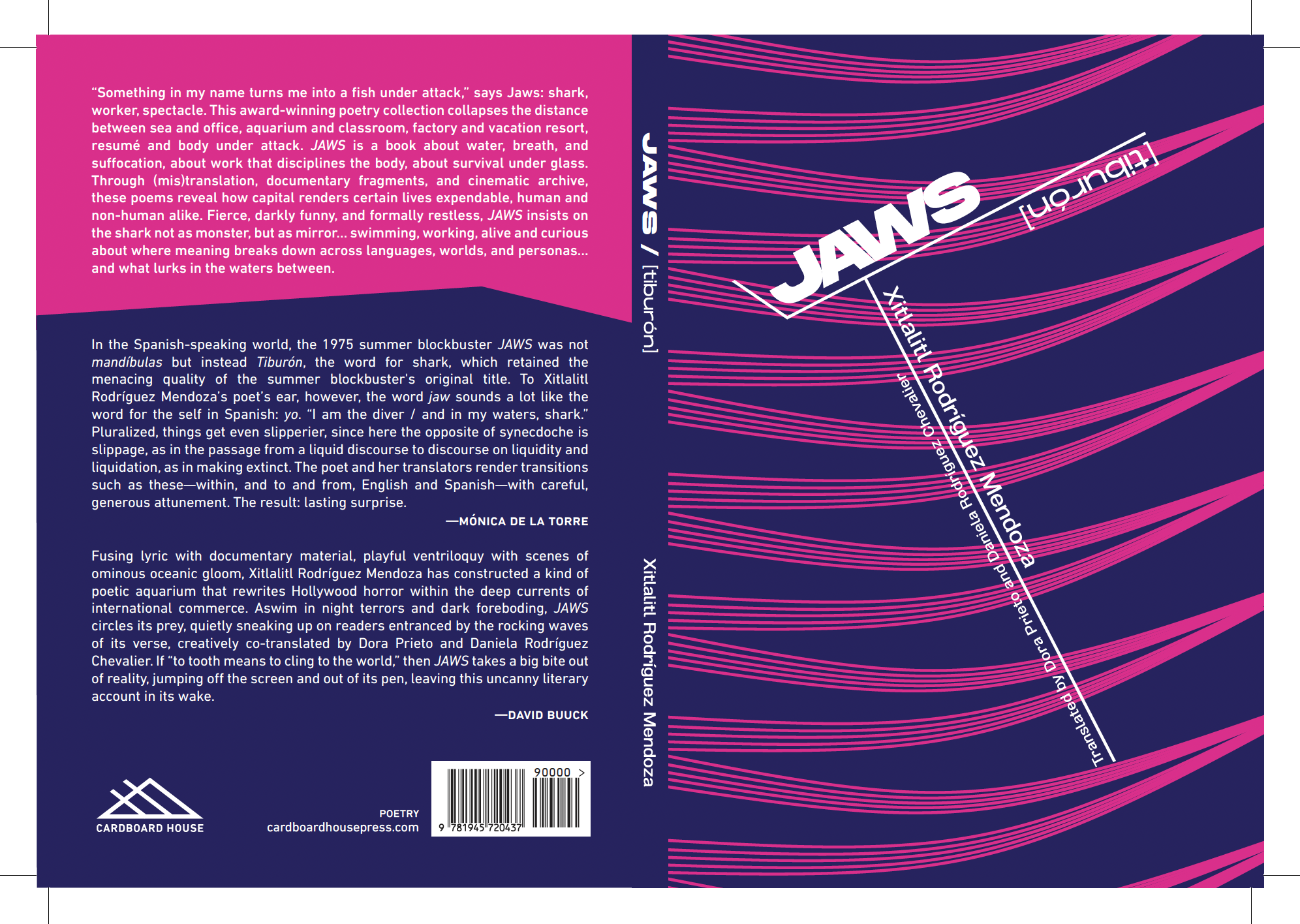
She is a 2025–27 Wallace Stegner Fellow at Stanford and has held residencies at Hedgebrook and the Banff Centre. She is the co-translator of JAWS [tiburón] by Xitlalitl Rodríguez Mendoza (Cardboard House Press, 2026). Her work has appeared in Best New Poets 2025, Catapult, and Maisonneuve, and she won the 2025 Bronwen Wallace Award for poetry. She is a co-founder of El Mashup Collective, and her practice moves across poetry, translation, textiles, and visual forms.
Her debut poetry collection is forthcoming with House of Anansi (April 2027)!
~ ~ ~





Praise for my Work
-
"Through thrilling leaps of association and rhetoric, Prieto's lines move like light through fibre-optic cables, connecting family and memory, belonging and alienation, violence and joy,"
- jurors Dallas Hunt, Matt Rader and Sanna Wani via the CBC.
-
"Notes on the Non-Place unfolds the shapes of the unique and common while inspecting the mourning and power of belonging, Dora Prieto whispers, cajoles, and shakes loose personal particles of the human journey."
- 2023 Bronwen Wallace jurors.
-
“In her manuscript Girls of the Now, Dora Prieto is skeptical of identities and asks important questions about the power a girl can wield when the future has become ‘a collection of disasters.’ Tracing interpersonal and familial connections through metaphor, Prieto suggests that poems are threads of embodied desire and extensions of blood’s trajectory. Her refusal to inhabit stable categories of ethnicity, gender, or monolingualism makes her poems exciting assemblages of language. Prieto’s youthful, worldly verse offers a sparkling example of what poetry can do right now.”
—Sonnet L’Abbé, 2024 WT Poetry Mentor.
Here is a poem:
-
Girls of the Now [Garments]
published in the 2025 Best New Poets anthology
Clothes are a better place for girls to keep their histories than stories.
—Anne Boyer
My favorite shoe brand is telling me to “take up space.” Subject line, email ad.
I am in my bikini and my armpits are sweaty.
My father is talking, in the way he does.
We are sitting by a desert hot spring near his home in central mexico.
I archive the ad, vaguely aware of his points:
Elections, yucatán, his mother’s strength, his father, missing.
A monologue, a “talking to oneself ” (late Latin) a declaration of his refusal to collaborate.
I psychoanalyze my father and all his secrets—but what do I know?
I am a silly little girl, which is both true and untrue.
It’s true in the sense that I am, despite my best efforts, north american.
Which means I am a girl believing lug sole boots and therapy could solve my emotional heritage.
The chunky military sole, reinforced leather toe, visible seams—
Today is the day I will heal!!!
Come on, I know girls are powerful.
When Kendall Jenner said does anybody even use snapchat anymore, the platform lost millions of users within twenty-four hours.
And in mexico city, Dua Lipa has made the lines long.
While the wall at the border is being built again.
Girls like these can change the shapes of cities with their joy.
When the ideals of consumerism align with the ideals of feminism.
I remember being relieved when we all started hating girl bosses.
Then: where does the high femme nihilism that replaced it take us?
I am sucking a mango pit; I toss the skin to the side.
There is no better time to leisurely contemplate gender than the peaceful white noise of a monologue.
I believe in the power of garments.
The crimson clasp, the bone-pleat detail, the soft cotton gusset.
See, there does exist a badass shoe, I wear it and my gender changes.
I won’t tell you the brand; a poem isn’t an ad.
Poems are ads for quitting your job.
Take up space, I say to myself in the bathroom mirror.
The stain of mango juice on my lips, a seam that bears memory:
As kids, we’d rub the pits all over our bodies like bars of sticky soap and then jump in the pool, washing it all away, to the distress of the nearby families.
Nasty little cochina rural canada things we were.
Before I was born, my mom had a shotgun hanging by the door.
That was her version of the boots.
She’d grab it to slug down birds for dinner or scare someone off.
She called it her husband, as in, don’t make me go get my husband.
The ad offers a cheap version of this recklessness.
My mother’s legacy as a wood worker, a lobster fisherman, hand work in the evenings.
I do hard labor jobs, I become a wildlands firefighter.
I get two degrees, become highly trained at synthesizing and speaking when called on.
And I buy silks, silvers, jean, sparkle spandex, linen weaves, a west coast dad fleece.
Is it all a kind of performance, even when it’s real?
A girl can be a first-gen grad, bilingual; a girl can work at it all.
A savvy promise drifts by on the breeze:
Illegible bodies can still be bodies of work.
The gun goes off. The hunter returns.
Three pheasants, stars retreating, in her hand.
CLOUDS: a love letter
Here is a translation:
-
Poem shop
by Andrés González
tr. by Dora Prieto
published on Asymptote
I wish I could write poems
all day every day
work hard
discover things
come back tired
after a long day
and the next day
open up shop
as if it were a fish shop
or a vegetable market
arrive early, clean, tidy up,
open the metal curtain
and sit down to serveif someone, you,
for example
were to come to my store
I would be writing
one poem and then another
and outside there would be a blackboard
where the available poems
would be listed
a poem about the shape
of the roots of the trees
about my mother’s varicose veins
about moonfish
my grandmother’s kidney
the shyness of clouds
my sister’s depression at 20
the taste of the sun
on the cat’s tongueyou could come in the morning and tell me
I need a poem
to clean my house again
or clean my heart, I don’t know
and I would say to you: sure, my friend,
I’ll have it for you tomorrow
or Friday at the latestand if you asked to pay me later
I would say of course
because poets always give on credit
and always
also
give away their books
those books that took them
years, pain, wonder, happiness perhaps
they give them away as if they were nothing
because we are fools and we don’t understand
that we shouldn’t trust, give away, and share
that these are acts
contrary to the economy
sins, debts
but the poets insist
because they want to be loved
and they are foolsand perhaps poetry has always been the trade
of the fools of society
and that’s fine
while capitalism tears apart
the fabric of life
it’s okay to keep on trusting and giving away
it’s okay to be the fools
and open early
every day
a shop that doesn’t exist
where we name pain and tenderness
where we still say
come in, friend